Welcome to the Mathematical World!
Hans Christian Ørsted
Pioneer Discoverer of Electromagnetism
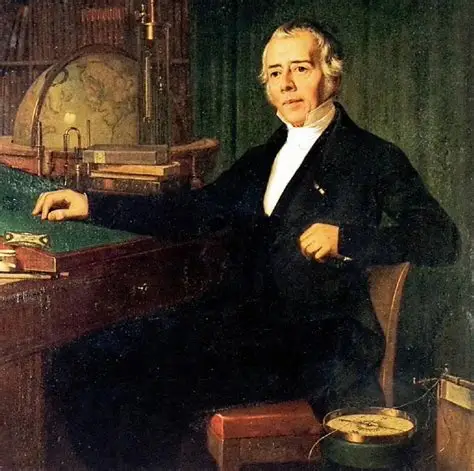
Hans Christian Ørsted (1777–1851) was a Danish physicist and chemist, best known for discovering that electric currents generate magnetic fields — the phenomenon now known as Ørsted’s law. Born in Rudkøbing, Denmark, Ørsted played a leading role in the Danish Golden Age of science and thought.
Early Life and Education
Ørsted was born into an apothecary family and studied pharmacy under his father before pursuing higher education. With encouragement from private tutors and personal determination, he passed the entrance exam to the University of Copenhagen in 1793 and received his doctorate in 1799 with a dissertation on metaphysics inspired by Kantian philosophy.
Professorship and Early Research
In 1806, Ørsted was appointed professor of physics at the University of Copenhagen, where he delivered popular lectures on electricity, acoustics, and philosophy. He experimented with Voltaic piles, inspired by Alessandro Volta's invention, and began to suspect that electricity and magnetism might be connected.
Discovery of Electromagnetism
In April 1820, during a lecture demonstration, Ørsted observed that a compass needle deflected when placed near a wire carrying electric current. This event marked the first experimental evidence that electricity generates a magnetic field.
He found that the magnetic field forms concentric circles around the wire, which can be described mathematically as:
$$\oint \mathbf{B} \cdot d\mathbf{l} = \mu_0 I$$
This is the integral form of Ampère’s law (later formulated by André-Marie Ampère), where \(\mathbf{B}\) is the magnetic field, \(I\) is the current, and \(\mu_0\) is the permeability of free space.
Impact and Influence
Ørsted's discovery sparked a rapid expansion of research in electromagnetism, inspiring scientists such as André-Marie Ampère, who developed mathematical formulations of magnetic forces, and Michael Faraday, who discovered electromagnetic induction. Faraday’s law is expressed as:
$$\mathcal{E} = -\frac{d\Phi_B}{dt}$$
where \(\mathcal{E}\) is the induced EMF and \(\Phi_B\) is the magnetic flux.
Chemistry and Popular Science
Ørsted’s scientific interests extended to chemistry. In 1820, he became the first to isolate piperine, the pungent compound in pepper, and in 1825 he discovered an early form of metallic aluminum.
He also founded the Society for the Dissemination of Natural Science in 1824, promoting science education among the public. Since then, the H. C. Ørsted Medal has been awarded for outstanding scientific communication.
Later Career and Legacy
Ørsted held his professorship at Copenhagen until his death in 1851, while also contributing to the foundation of Denmark’s first polytechnic institute, now the Technical University of Denmark (DTU).
His name endures in the unit of magnetic field strength in the CGS system — the oersted — and in Denmark’s first satellite, launched in 1999. He is also commemorated by statues, medals, and park names throughout Copenhagen.
Legacy in Science
Ørsted’s contributions marked the birth of electromagnetism as a unified scientific field, fundamentally changing how we understand and harness electricity and magnetism. His pioneering work paved the way for modern electrical engineering, telecommunications, and magnetic sensors, earning him a place among history's most influential physicists.

All rights reserved by the Mathematical Unity
Contact: +8801400044645
Email: mathematicalhorse1453@gmail.com
Our Discord Server: Mathematical Unity [Ulus Riyadiyat]